Overview
In Phase I, we focused on improving customization experiences with AI. As we explored the broader desktop experience, we discovered that the problem goes beyond customization.
The Problem
Traditional UI is intent-blind, exposing too many options and forcing users to navigate fragmented apps, tabs, and desktop surfaces just to complete simple tasks.
Opportunities
Analyzing these challenges inspired us to envision a new way of interacting with interfaces, much like Iron Man interacts with JARVIS.
Static destinations
Information-compact interfaces that reflect application boundaries.
Intent-driven interaction
Task-specific surfaces that emerge and dissolve as needed.
Design Insight
As AI improves in understanding natural language, reasoning through tasks, and handling execution, people no longer need to translate their intent into technical systems or fragmented workflows. AI can instead act as the bridge between what users want and how the system carries it out.
AI Desktop Agent Beta
Initial Prototype
Instead of navigating through layers of apps, users can simply describe what they want to do. Cosmo then handles the steps and returns the result as a clean widget directly on the desktop.
Manually connecting apps to an AI agent is slow and cumbersome.
Generating widgets through LLM-written UI code can be slow.
The visual quality of generated widgets is not always consistent.
Improved Prototype
Using Composio, we eliminate manual app integration by directly connecting hundreds of apps to our AI agent.
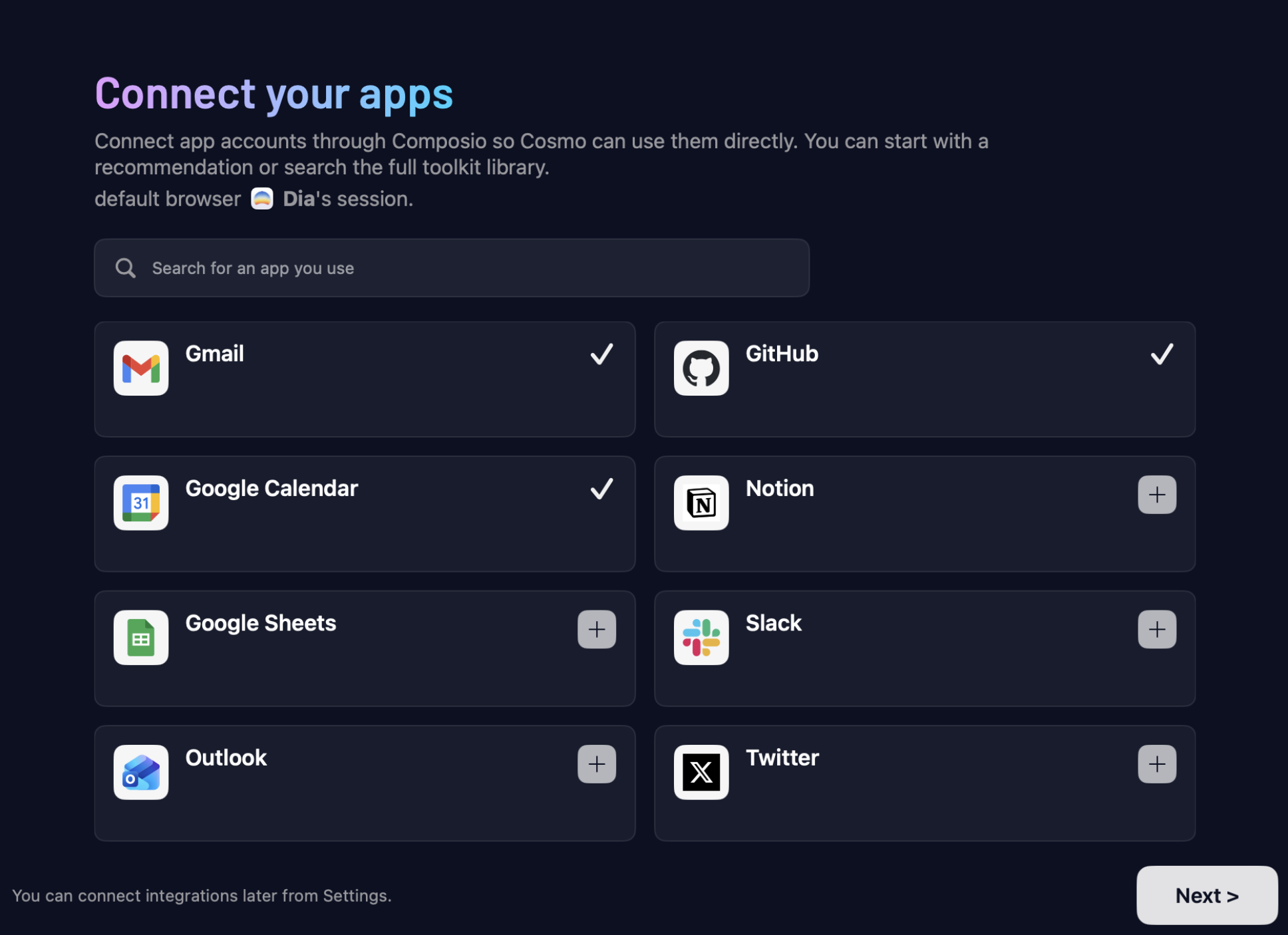
The improved prototype eliminates much of the manual integration effort, greatly reduces generation latency, and preserves UI quality.
Where We’re Headed
Cosmo is our attempt to explore that future: a workspace where intent becomes the interface.
Reflection
This project helped clarify that the future of desktop experience is not just visual customization. It is about reducing friction between what users want and what the system requires.